
South Carolina Court Records After Arrest
Booking and court filing are related, but they are not the same record. A county jail roster shows the booking side: custody status, booked charges, bond when listed, and the holding facility. Court records after an arrest show the legal case: charging documents, hearings, charge status, disposition, and sentence. A case may be filed in the county where the offense is charged even when the person is later held somewhere else.
South Carolina's statewide court search framework routes users to county Public Index records. The research notes that the South Carolina Judicial Branch case-records search page links every county Public Index and states that some Municipal Court records are available.
Search South Carolina Court Records
The court path starts with the statewide Judicial Branch case-records landing page or the Public Index portal. Search by defendant name or case number, then choose the county where the case is filed. A person may be held in a regional jail, transferred to SCDC, or moved to federal custody while the state case remains visible in the county court index.
The South Carolina Public Index portal is the court-record source captured for statewide case searching.
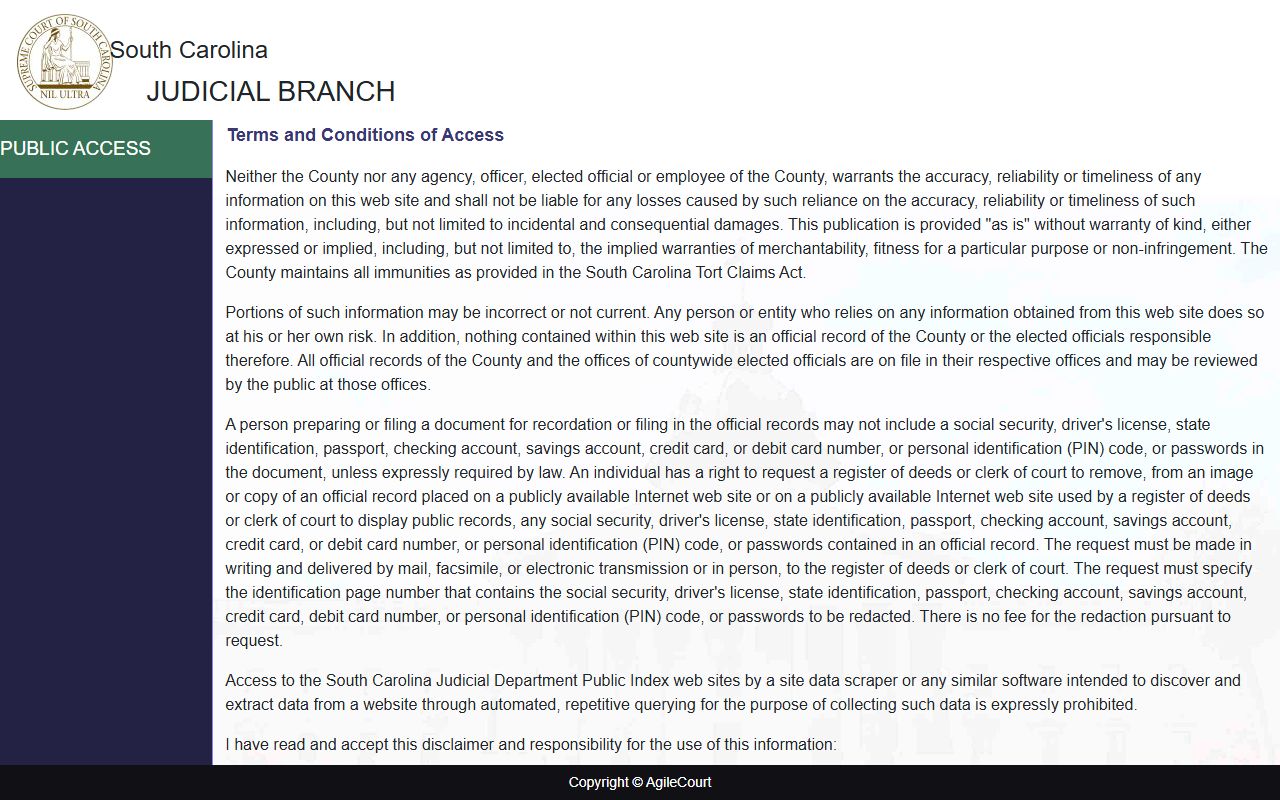
The portal is for court case information. It is not a live inmate roster and does not prove where a person is housed today.
- Open the Public Index or the Judicial Branch county case-record link.
- Select the county where the criminal case was filed.
- Search by defendant name or case number.
- Open the case and review charges, hearing dates, disposition, and sentencing entries.
- Confirm live custody with the county roster, SCDC, BOP, ICE, or VINE as needed.
Arrest to Court Record
The basic path is arrest, booking, first appearance or bond review, prosecutor filing, court case, hearings, disposition, and sentencing if there is a conviction or plea. Booking charges can differ from charges later filed by the prosecutor. A jail roster can keep an old booked charge while the court record shows amendment, dismissal, indictment, plea, or sentencing.
| Stage | Record Source | What to Check |
|---|---|---|
| Arrest and booking | County jail roster | Custody, booking date, booked charges, bond |
| First appearance | Court or magistrate record | Bond and initial charge handling |
| Prosecution | Public Index | Filed charges and case status |
| Sentence or transfer | Court, jail, or SCDC | Judgment, prison transfer, or release |
Complaint, Information, Indictment
Court records after a jail arrest often turn on the charging document. The research did not provide a South Carolina county-by-county form list, so the statewide page should define the common criminal-case terms without pretending every county labels each entry the same way.
| Document | Plain Meaning | Reader Caution |
|---|---|---|
| Complaint | A sworn accusation or initial charging record. | May not be the final filed charge. |
| Information | A prosecutor-filed charge in some criminal matters. | Read later amendments and dispositions. |
| Indictment | A grand-jury charging document for serious charges. | Not proof of guilt. |
Charge Status After Arrest
Charge status can change quickly. Pending means the charge is still open. Amended or reduced means the prosecutor or court changed the charge. Dismissed means the charge was ended by court action. Nolle prosequi means the prosecution did not proceed on that charge. A conviction means a guilty verdict or plea has been entered, but sentencing and custody can still require separate review.
| Status | Meaning |
|---|---|
| Pending | The case or charge has not reached final disposition. |
| Amended or reduced | The charge was changed from the booked or earlier filed version. |
| Dismissed | The court ended the charge without a conviction on that count. |
| Nolle prosequi | The prosecutor did not proceed on that charge. |
| Convicted | A verdict or plea produced a conviction, but sentence details still matter. |
Bond and Custody Holds
Bond information may appear on a jail roster, court entry, or both. A cash bond usually requires payment of the set amount. A surety bond involves a bond company. A personal-recognizance bond releases a person on a promise to appear. A no-bond hold, detainer, or hold for another agency can prevent release even when another charge has a bond amount listed.
Important: Verify bond and release with the official jail or court before traveling or sending money.
Charges vs Convictions
An arrest or charge is not a conviction. South Carolina court records after an arrest can show allegations, amendments, dismissals, pleas, verdicts, and sentences. Public records can be useful, but they must be read by status and date.
| Charge | Conviction | |
|---|---|---|
| Meaning | An accusation filed or booked. | A guilty plea or verdict. |
| Custody effect | May affect bond or holds. | May lead to jail, probation, SCDC, or supervision. |
| Record caution | Can be changed or dismissed. | Still may be appealed, sealed, expunged, or followed by supervision. |
Sealed and Expunged Records
The research provides a broad warning, not a detailed expungement chart: charges can be amended, dismissed, expunged, sealed, or resolved differently from the booking charge. Juvenile records, medical records, victim information, security plans, and some law-enforcement records may be restricted. Public court search results may also omit information that is exempt, sealed, or no longer displayed.
| Sealed | Expunged | |
|---|---|---|
| Public view | Hidden from ordinary public access. | Removed or treated as cleared under the applicable order. |
| Agency access | May remain available to limited officials. | Depends on the order and statute. |
| Search caution | A missing public entry may not mean no case ever existed. | Use the court or attorney for official interpretation. |
FOIA and Court Limits
South Carolina FOIA supports access to public records, but court records, jail records, juvenile records, and law-enforcement records can be restricted by other law or exemption. Section 30-4-40 includes exemptions for privacy and law-enforcement records where release would interfere with proceedings or endanger safety.
The South Carolina FOIA statute frames why some jail and court-adjacent records are public while other records are withheld or redacted.
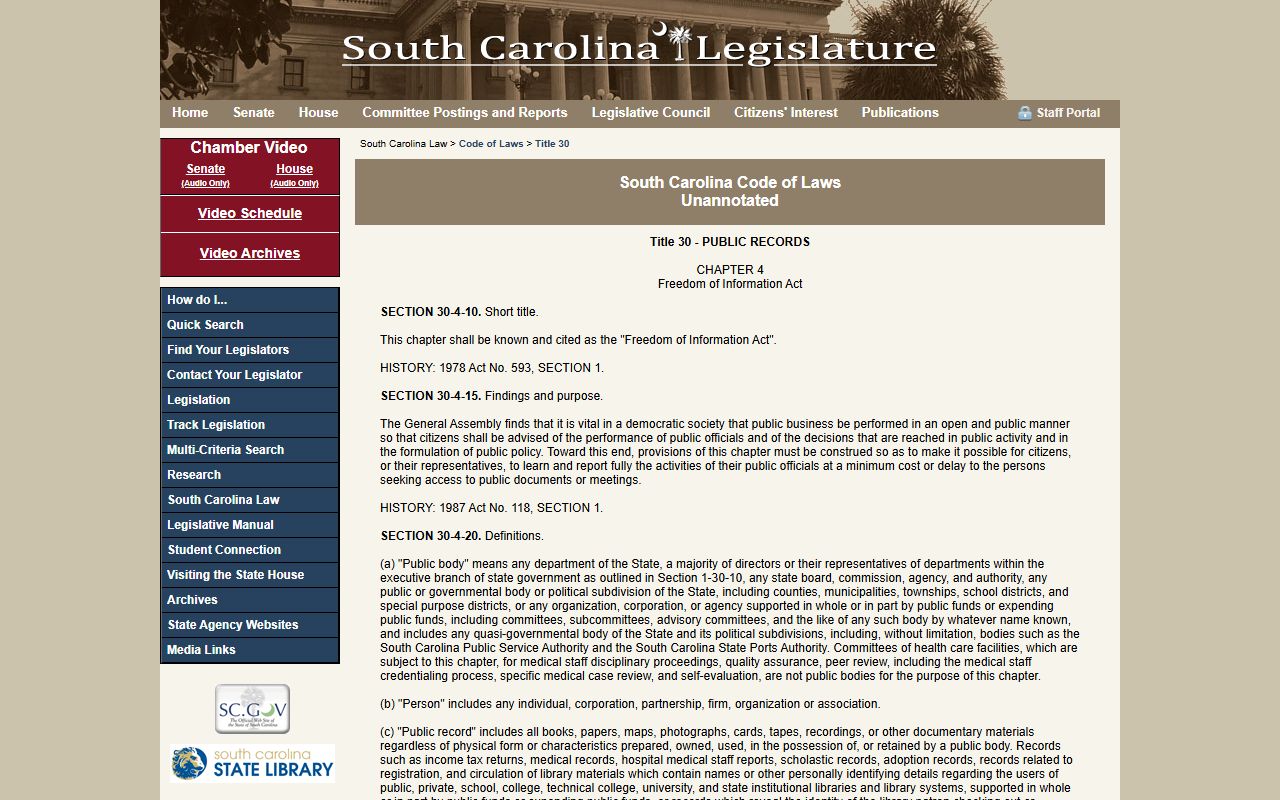
Public does not mean every police file, juvenile matter, medical record, victim detail, or security record appears online.
Custody After Sentencing
If a South Carolina case ends in a state prison sentence, the custody search may move from county jail to SCDC after transfer and classification. The Public Index can show the court case, while SCDC shows the prison location. For a federal sentence, BOP is the locator. For immigration detention, ICE ODLS is the locator.
The SCDC inmate search is the sentenced state-prison locator used after transfer into SCDC custody.
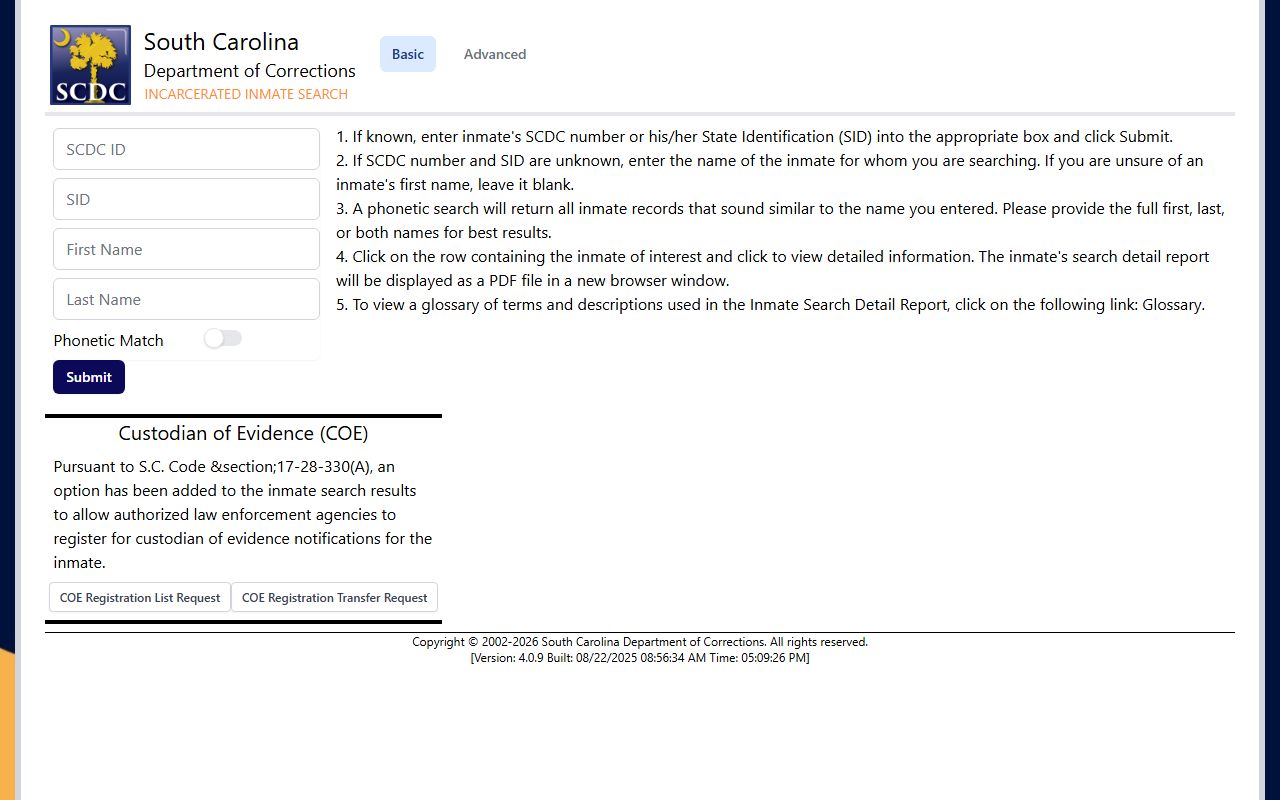
That separation keeps court outcome, jail booking, and prison placement in the correct systems.
Notification After Arrest
Victims, witnesses, and family members may need notice when custody status changes. South Carolina VINELink is the statewide notification source identified in the research. It should be used with, not instead of, the court index and the holding agency's roster or locator.
The South Carolina VINELink page is the custody-notification source for supported cases and facilities.
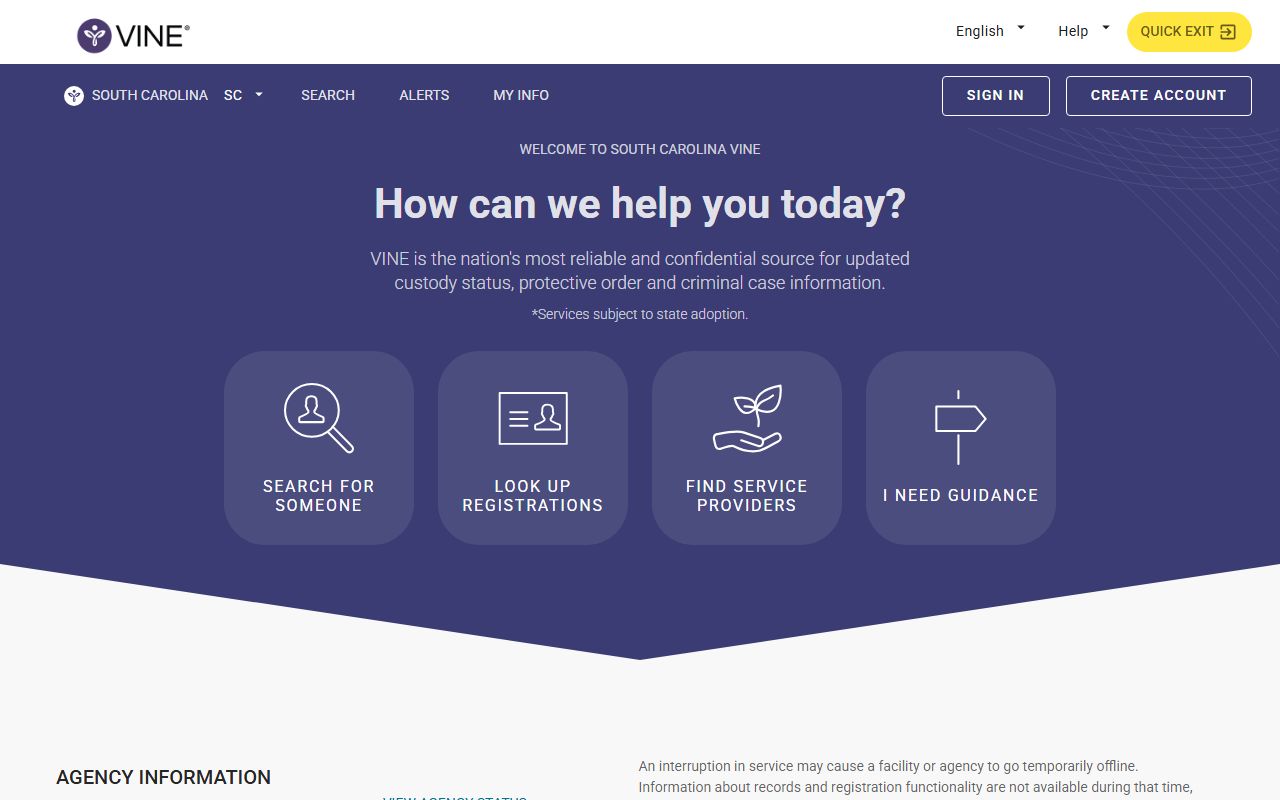
Notification is especially useful when a roster can change faster than a person can check it manually.
County Filed vs County Held
South Carolina court records after an arrest should be searched in the county where the case is filed, not only where the person is currently housed. A person may be held in a regional detention center, moved on another county's warrant, transferred to SCDC after sentencing, or held in federal custody while a state case remains visible in the county Public Index. The court record follows the case. The custody record follows the jail, prison, federal agency, or immigration custodian.
This distinction matters in regional arrangements. Orangeburg and Calhoun share regional detention context. Lee and Sumter research includes regional routing. Richland has a local detention center and several SCDC facilities in the same county. A court search should use the case county, while a custody search should use the current holding agency.
Public Index Display Limits
The South Carolina Judicial Branch research includes practical browser and display limits. Public case-record searches require cookies and JavaScript, and some browsers require a pop-up exception to view case detail. The research also notes a statewide display change: as of January 1, 2026, home address information will no longer be displayed on the public index for new and existing cases. That absence should not be treated as a missing case or a broken search.
Public Index results also have to be read with record-status caution. A charge may appear before a final disposition, and a final disposition may not explain current custody by itself. For custody, search the jail, SCDC, BOP, ICE, or VINELink path that fits the person. For legal effect, read the court entry and consult the official court or attorney rather than treating a search result as legal advice.
Public Record Search
Sponsored Results